

Both father and son, Ajoy and Pranoy Thipaiah, are deeply involved in nearly every aspect of Kerehaklu Estate, though each has naturally gravitated toward areas where their experience and instincts best serve the farm. Ajoy uses his 35 years of experience to manage the coffee trees sustainably, focusing on plant health and overall agronomy, while Pranoy took over post-harvest processing management five seasons ago, applying his background in biology to introduce carefully managed experiments.
For five generations, the Thipaiah family have been producing coffee on the biodiverse land of Kerehaklu Estate in Chikmagalur, India. The 97-hectare plantation is located in the Western Ghats, where shade from tall trees prolongs bean development and allows berries to ripen at a steady, unhurried pace. Coffee grows alongside the jungle here, with fig, betel nut, jackfruit, avocado, and citrus trees, as well as wild elephants, bison, and tigers.
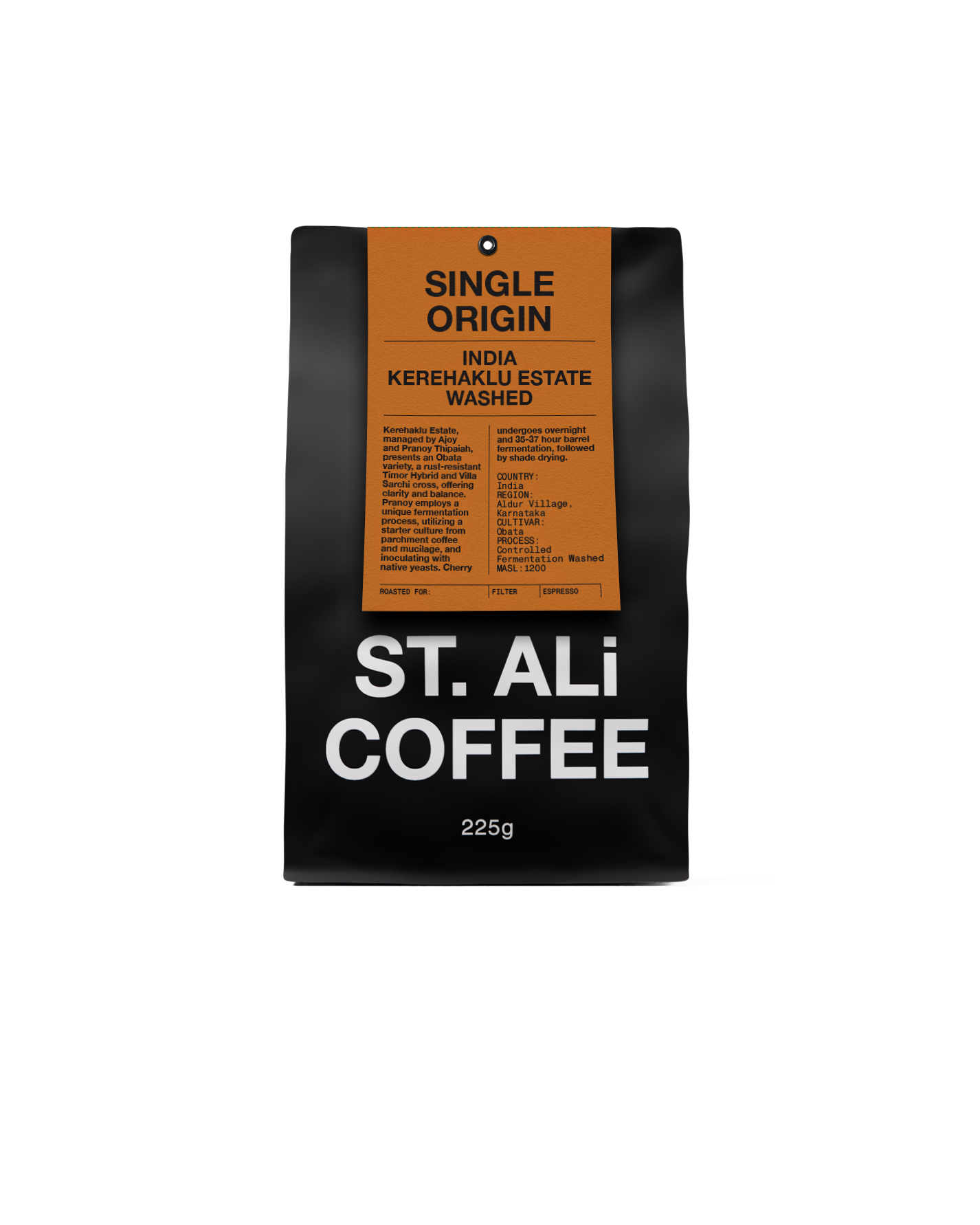
This lot features the Obata variety, a cross between Timor Hybrid and Villa Sarchi developed by Brazil's Instituto Agronômico in 2000. Obata is highly resistant to coffee leaf rust and well-suited for high altitude cultivation, producing very high yields. The variety is known for producing coffee with clarity and balance, typically featuring delicate acidity with notes of citrus, or presenting as rich and chocolatey with a creamy body and long finish.
Pranoy's approach to processing has evolved remarkably over the past four seasons. Around 2019, he realized that traditional Indian processing wasn't allowing the beans to express their full potential. He's deeply curious about how processing can add nuance and character to coffee, yet he's equally committed to allowing plant genetics and the native microbiome to remain the dominant forces shaping flavor. While he occasionally uses commercial yeasts for certain lots, he prefers to use local microbes found in the environment, celebrating the estate's incredible microbiome cultivated through their farming practices.
Pranoy's method mirrors sourdough bread making: he creates a starter culture using parchment coffee and mucilage. The native yeasts and bacteria activate within this mixture, which is then cultivated into a vibrant starter culture used to inoculate fermentations.
A typical Kerehaklu lot is processed as follows: Freshly harvested cherry is floated the same day it's picked, then placed in open-air fermentation tanks from approximately 6:00 p.m. to 9:00 a.m. the following morning. After this overnight fermentation, the coffee is pulped and transferred to lidded plastic barrels containing fresh water and a measured amount of starter culture. The coffee is stirred every few hours to introduce oxygen and ensure uniform fermentation. After 35 to 37 hours, it is mechanically washed and moved to drying. Drying begins under heavy shade for the first two days, after which the coffee is transferred to a polyhouse for continued drying.